The ERP Solution for the Year” 2025 in Agtech Breakthrough Awards 2025

Modernizing Multi-Entity Farm Operations with AgriERP

Implementing Microsoft Dynamics 365 Business Central and AgriERP to unify multi-company accounting, crop project management, harvest processing, sales contracting, intercompany cost flow, and field-to-finance traceability for a complex US farming group.

TECHNOLOGY USED

Our Happy Customers

Client Overview

Four Little Devils (4LD) is a multi-entity farming and crop business based in the United States, operating across five legal entities with separate responsibilities for farm operations, crop ownership, land, equipment, and group consolidation.

The organization manages a range of agricultural activities including production farming, crop ownership, harvest operations, marketing sales contracts, intercompany investment activity, and consolidated financial reporting. As the business grew across entities, crop cycles, and harvest events, its operational complexity increased significantly.

Before the AgriERP implementation, teams depended on a legacy Dynamics NAV-based Agri accounting environment with manual reconciliation, disconnected field and finance processes, and limited visibility into crop project performance, harvest quantities, and intercompany cost flow.

To support continued growth, 4LD needed an enterprise-grade ERP ecosystem that could connect agricultural operations with multi-entity financial management and give finance and operations a shared source of truth. Folio3 implemented Microsoft Dynamics 365 Business Central with AgriERP to create that connected foundation.

Industry

Multi-entity farming and crop operations

Location

United States

Organization Size

Multi-entity group (5 legal entities)

Operational Focus

Production farming, crop ownership, harvest operations, marketing sales contracts, and intercompany cost management

Problem

4LD had outgrown its legacy NAV-based Agri accounting environment. Farm operations, harvest activity, crop projects, sales contracts, intercompany transactions, and financial reporting were managed across disconnected systems and manual workflows, creating visibility gaps, correction risk, and delayed decision-making.

Need

The business needed a centralized ERP ecosystem to unify multi-entity financial management, agricultural hierarchy, crop project costing, harvest processing, sales contracting, intercompany activity, and operational traceability across all five entities.

Solution

AgriERP implemented Microsoft Dynamics 365 Business Central integrated with the AgriERP platform, creating a scalable farm ERP foundation for finance, crop operations, harvest management, sales contracting, intercompany project processing, and future innovation.

Business Challenges Before AgriERP

As Four Little Devils scaled across entities and crop cycles, operational and financial teams needed more than a legacy system and manual coordination. The organization required a structured ERP foundation that could support legal-entity separation, controlled harvest corrections, crop project traceability, contract visibility, and intercompany cost alignment between the farming company and the crop ownership entity

Disconnected Legacy Systems
Delayed Inventory Reconciliation
Manual Warehouse Transactions

Manual Production Records
Limited Inventory Visibility
Inconsistent Lot & Pallet Tracking
Disconnected Data & Reporting
Uncoordinated Transportation

Implementing AgriERP for Connected Farm Operations

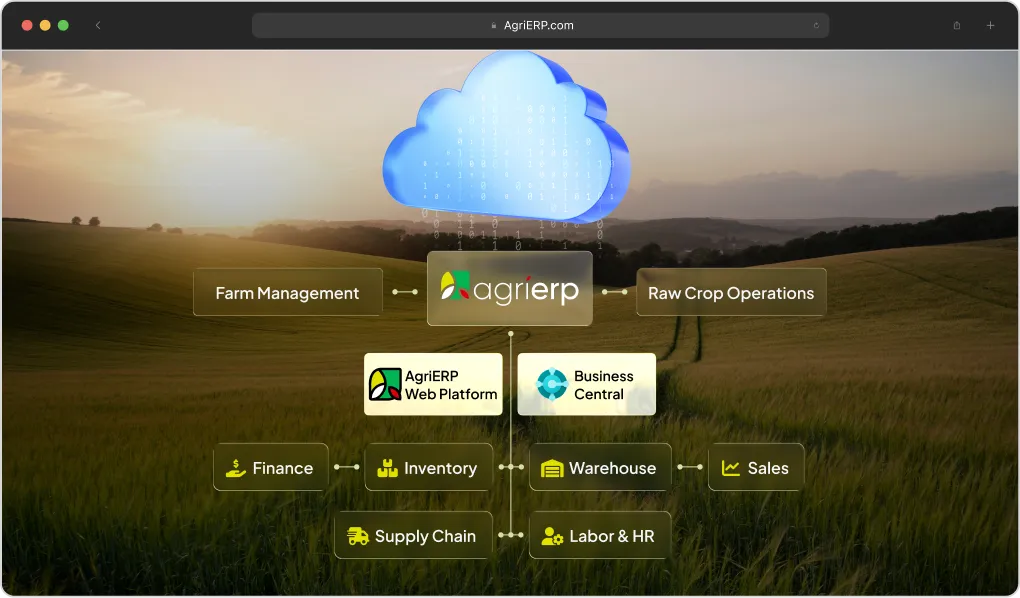
Folio3 implemented a comprehensive AgriERP ecosystem powered by Microsoft Dynamics 365 Business Central. The solution was designed to unify multi-entity finance, agricultural hierarchy, crop project management, harvest processing, sales contracting, intercompany cost flow, and operational reporting within one connected digital platform.
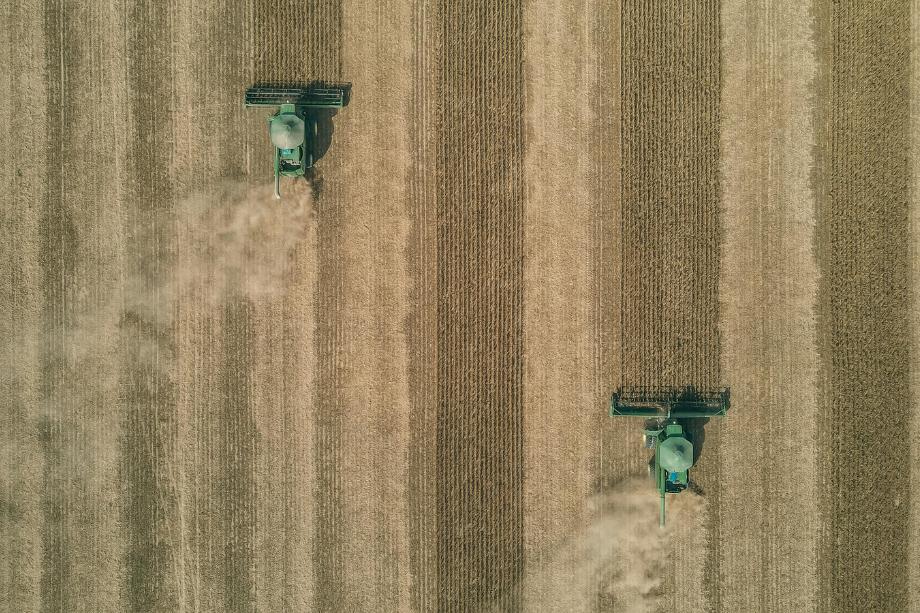
Business Central served as the core ERP foundation across all five legal entities, while AgriERP extended the platform into agriculture-specific workflows including crop projects, production contracts, marketing sales contracts, harvest posting, and intercompany project processing. This allowed 4LD to capture farm activity within controlled ERP transactions, connect that data with financial posting and inventory movement, and give management faster visibility into crop performance and entity-level results.

The implementation focused on connecting field-level agricultural activity with back-office finance at the source. Farm and finance users could work from the same ERP data, reducing dependency on spreadsheets, manual reconciliation, and informal correction processes.

The Solution

The implemented solution combined enterprise ERP capabilities with agriculture-specific workflows. Microsoft Dynamics 365 Business Central modernized financial and operational management across five companies, while AgriERP enabled agricultural hierarchy, crop project management, harvest operations, sales contracting, and intercompany cost control.

Financial Management and General Ledger

Centralized accounting through Business Central, including chart of accounts configuration, general ledger setup, posting groups, fiscal calendar (May–April), dimension setup, and consistent financial reporting across the 4LD group.

Accounts Payable and Receivable

Standardized AP and AR workflows with vendor and customer posting groups, purchase and sales order processing, and improved transaction tracking across business cycles.

Banking and Bank Reconciliation

Entity-specific bank accounts configured for computer checks, manual checks, ACH, wire processing, EFT payment runs, deposits, and bank reconciliation across the group.

Fixed Asset Management

Structured tracking of fixed assets including acquisition, depreciation, and disposal entries within the Business Central environment.

Inventory and Warehouse Management

End-to-end inventory traceability covering item master control, item tracking, location management, and inventory movement connected to crop harvest and sales activity.

Procurement and Purchasing Workflows

Standardized purchasing processes from purchase orders through vendor invoicing, giving 4LD tighter control over procurement activity and operational spend.

Sales Order Processing and Contracting

Production sales contracts and marketing sales contracts supporting the full sales-to-delivery cycle, including shipment assignment, proof-of-delivery tracking, contract statistics, and quantity visibility.

Intercompany Accounting and Consolidation

Multi-entity accounting workflows enabling intercompany transactions between 4LDF and PPLLC, group consolidation through the TE holding entity, and consistent financial operations across related business units.

Farm Operations Execution (AgriERP)

AgriERP process layer enabling production sales contracts, marketing sales contracts, harvest project management in PPLLC, and crop cost accumulation connected to the farming company's production activity.

Project Accounting and Agricultural Hierarchy

Agricultural hierarchy covering grower, growing site, growing area, and growing plot. Crop project management with master tasks, planning lines, task-level cost review, operational area tracking, and budgeted harvest quantity visibility.

Reporting, Analytics, and Scalable Foundation

Standard Business Central reporting connected to a scalable ERP foundation ready for Power BI dashboards, approval workflows, mobile field capture, advanced warehousing, and future agriculture-specific process expansion.

Functional Design and Customizations Delivered

A major success factor of the Four Little Devils implementation was the design of custom agricultural workflows that matched the organization's multi-entity operating model. These enhancements reduced manual effort, improved process consistency, and connected farm execution with ERP financial and inventory data.

Harvest Posting Functionality

Because the Farm App and Mobile App were not in scope for Phase 1, Folio3 enabled harvest posting directly from the Business Central Project Card.

Only project task lines with Master Task Type set to Harvest allow posting. Users enter quantity in a Qty to Harvest field, with Harvest Qty Posted tracking cumulative posted quantity.

The system automates downstream purchase order, receipt, transfer order, sales order, journal, and valuation impacts for both internal and external harvest scenarios.

Inventory, project cost, and financial posting remain aligned without manual entry chains.

Adjust Harvest Functionality

Supports positive and negative adjustments to already-posted harvest quantities while maintaining linkage to original harvest tickets.

The system calculates incremental quantity as Final Harvest Qty minus Original Harvest Qty.

Applies appropriate logic for open and completed projects including true-up recalculation, inventory movement correction, and cost-per-unit adjustment.

Intercompany synchronization is handled where 4LD's process requires cross-company alignment.

Project Split Functionality

Allows users to transfer posted costs from a pre-planting project to multiple target projects using area-based proportional allocation.

The system prevents splits after harvest activity has been posted and enforces project-type matching.

Task mapping, planning line references, and budget baseline fields are preserved for audit traceability.

Finance can audit which costs moved, which target projects received them, and which planning and task references were involved.

Marketing Sales Contracts

Built on the Blanket Sales Order framework, extended with contract-specific fields for agriculture-specific crop sales management.

Tracks shipped, invoiced, and remaining quantity against the contract rather than only contract amount.

Supports shipment assignment and reassignment, contract terms, adjustment factors, and proof-of-delivery requirements based on customer configuration.

Growing Cycle dimension flows from the contract header into contract lines for agricultural cycle context.

Intercompany Project Processing

Automates harvest project creation in PPLLC from production sales contracts in 4LDF.

Carries crop, growing cycle, grower, site, area, plot, operational area, and harvest project data into the related company context.

Intercompany invoice costs are recorded as investment costs on the PPLLC harvest project.

Preserves traceability between the production contract, intercompany project, and posted IC invoices.

Planned Cost Visibility

Planned Cost is surfaced on project planning lines, populated from the Unit Cost on the corresponding master planning line when a master task is imported.

A Planned (Total) Cost FlowField on project task lines sums planned cost across planning lines for the same project and task.

Posting logic is unchanged; the field provides visibility without affecting the item cost basis used for actual posting.

Project reviewers can compare planned cost assumptions against item cost used for posting without navigating back to setup records.

Check Layout

Standard Business Central Report 10411 customized to match 4LD's required check and stub layout.

Includes posting date, payment amount, amount in words with leading star characters and US DOLLARS formatting, vendor details, document references, discount, net amount, and total values.

Pre-printed elements such as check number and company logo are handled as pre-printed where applicable.

Supports day-to-day payment printing aligned with operational banking requirements and vendor payment expectations.

Implementation Methodology

AgriERP followed a structured phased implementation methodology to minimize disruption, align stakeholders, and support user adoption across 4LD's five entities.

User Acceptance Testing and Release Management

The Four Little Devils implementation included structured User Acceptance Testing covering the full scope of finance and agricultural workflows across all five entities. Users executed test cases independently after training, with Folio3 support available during assisted UAT.

Issues identified during testing were reviewed, corrected, and retested before formal sign-off. Custom development was validated in non-production environments before production deployment, and hypercare support was planned after go-live.

Financial posting, general ledger, and dimension validation

Banking, payment, ACH, EFT, check reconciliation testing

Agricultural hierarchy, crop project, and planning line testing

Production sales contracts and marketing sales contracts

Internal and external harvest posting scenarios

Adjust Harvest positive and negative scenarios across open and completed projects

Project Split cost transfer and validation rule testing

Intercompany Project Processing and IC invoice cost flow

Planned Cost visibility and check layout output

User manuals, release notes, and formal sign-off before production deployment

Business Impacts of AgriERP for Four Little Devils

The AgriERP deployment helped Four Little Devils move from a legacy NAV-based environment and manual, fragmented processes to a connected ERP ecosystem where finance, inventory, harvest, crop contracting, intercompany cost flow, and reporting work together across five legal entities.

Finance and Control Outcomes

Operational and Agriculture Outcomes

Management and Decision-Making Outcomes

Future Roadmap and Scalability

The implemented solution gives 4LD a controlled Phase 1 foundation while leaving room for additional governance, agriculture, inventory, reporting, and integration capabilities in future phases.

Approval workflows for vendors, payments, purchase orders, items, and fixed assets
Expanded role security and user governance across companies and functions
Crop insurance, FSA-578, producer information, state and county reporting, and integrated agriculture compliance views
Land lease agreement functionality and expanded leasing automation
Advanced inventory enhancements including inventory counting, warehouse management, shrinkage, expiration-date tracking, and lot merging
Payroll journal automation or Paycom integration
Additional Power BI dashboards, cost-center analysis, crop performance reporting, and executive scorecards
Future Farm App or mobile workflows for direct field capture when the business is ready

Ready to Connect Your Farm's Finance, Inventory, and Multi-Company Operations?

Discover how AgriERP on Microsoft Dynamics 365 Business Central helps growing farms centralize accounting, banking, purchasing, sales, inventory, fixed assets, and multi-company reporting in one scalable ERP foundation.

AgriERP Media Mentions

Partners & Affiliations

Frequently Asked Questions

What challenges did Four Little Devils solve with AgriERP?

4LD addressed legacy system limitations, disconnected field and finance processes, manual harvest corrections, limited crop project visibility, intercompany cost traceability gaps, unstructured contract tracking, and manual spreadsheet dependency across five legal entities.

Business Central served as the core ERP foundation for multi-entity financial management, accounts payable, accounts receivable, banking, fixed assets, inventory, intercompany accounting, consolidation, sales order processing, and reporting across all five 4LD companies.

AgriERP enabled agricultural hierarchy for growers, sites, areas, and plots; crop project management with master tasks and planning lines; production and marketing sales contracts; harvest posting directly in Business Central; harvest adjustment; project split; and intercompany project processing between 4LDF and PPLLC.

Key customizations included Business Central-based harvest posting, controlled harvest adjustment with trueup logic, area-proportional project split, marketing sales contract management with shipment assignment and proof-of-delivery, intercompany harvest project creation from production contracts, planned cost visibility on project planning and task lines, and a customized check layout.

The solution connects harvest quantity posting, harvest ticket references, inventory movement, project cost, and intercompany cost flow within controlled ERP transactions. This improves traceability from field activity through to financial posting across entities.

Field and farm activity captured through AgriERP flows into project costing, inventory movement, sales contracts, intercompany invoices, and financial posting in Business Central. This reduces delays between farm execution and back-office financial reconciliation.

The implementation helped centralize multi-entity finance and operations, replace legacy constraints, improve harvest and project traceability, standardize payment and banking processes, connect intercompany cost flow, and create a scalable ERP foundation for future growth.

Yes. The Four Little Devils implementation demonstrates how AgriERP can support complex multi-entity US farming operations with separate company books, intercompany transactions, consolidated reporting, crop ownership structures, and agriculture-specific workflows across the group.