The ERP Solution for the Year” 2025 in Agtech Breakthrough Awards 2025

Digitizing Operations for a 30,000 acres Potato Grower with AgriERP

Migrating from QuickBooks to Microsoft Dynamics 365 Business Central with AgriERP to centralize farm operations, strengthen financial visibility, improve reporting, and support scalable agricultural growth.

Our Happy Customers

Multi-Entity Financial Consolidation

From Weeks to 1.5 Hours

Standardized accounts and automated intercompany transactions cut consolidation time from weeks to just 1.5 hours.

Monthly Financial Close Target

Within 5–7 Days

Structured ERP workflows replaced legacy tools, enabling a 5-to-7-day monthly close and unlocking operational visibility.

Internal Data Confidence Score

From 3/10 to 8/10

Consolidating eight legal entities into one ERP platform gave leadership a trusted single source of truth for strategic decision-making.

Measurable Impact Delivered

Real business outcomes delivered by consolidating AgriERP clients onto Microsoft Dynamics 365 Business Central, creating a unified platform that streamlined operations, standardized business processes, and improved financial visibility across the organization.

Client Overview

The client is a family-owned and operated potato farming business in the United States with multi-generational agricultural experience. The operation manages a large farming footprint and produces potatoes along with other rotational crops across multiple farms and locations.

As the business expanded, its leadership team needed more than a basic accounting system. The farm required a connected platform capable of supporting crop management, financials, inventory, supply chain, vendor and grower management, reporting, and day-to-day operational visibility.

The client was committed to sustainable growth and the adoption of smarter technology to improve operational control. However, its existing setup around QuickBooks and disconnected tools had started limiting visibility, scalability, and timely decision-making.

Organization Type

Large-scale family-owned farming operation

Primary Crop Focus

Potatoes, with additional rotational crops

Industry

Farming and Agriculture

Legacy System

QuickBooks and disconnected operational tools

Target Platform

AgriERP on Microsoft Dynamics 365 Business Central

Problem

The farm was managing core operations through QuickBooks and disconnected applications. As operations grew, manual processes, siloed data, limited reporting, and scalability issues began affecting business efficiency.


Need

The client needed a system that could support crop management, financials, inventory, supply chain, vendor and grower processes, and real-time reporting from one centralized platform.

Solution

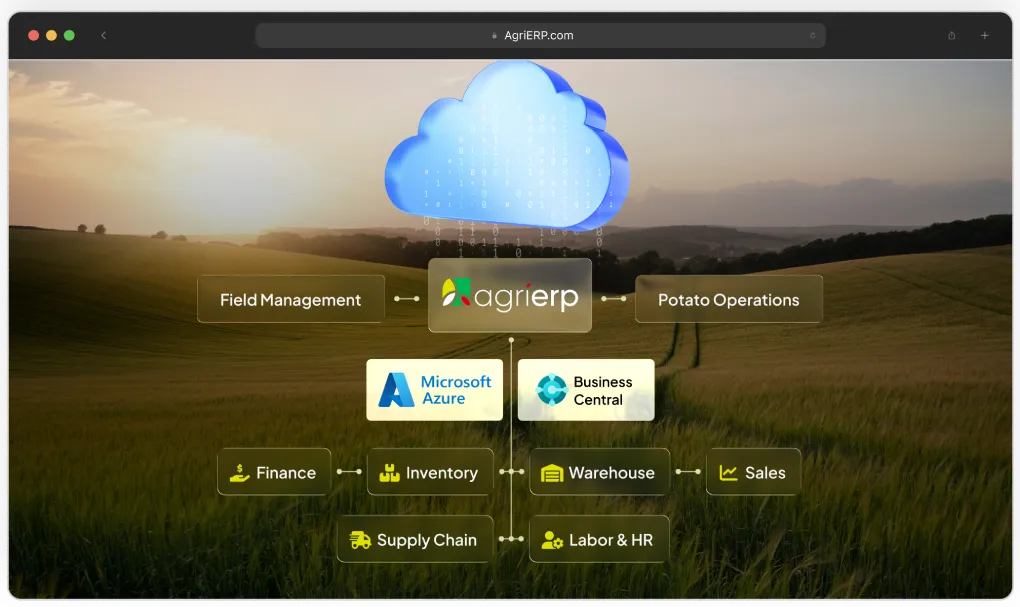
AgriERP helped the client transition from QuickBooks to Microsoft Dynamics 365 Business Central, creating an integrated farm management platform across finance, inventory, supply chain, sales, reporting, and operations.

Challenges with the Legacy System

Before implementing AgriERP, the farm relied on QuickBooks as the primary business system. While this setup supported basic accounting needs, it became difficult to scale as the operation expanded across multiple farms, locations, crops, vendors, growers, and supply chain activities.

The lack of integration with other agricultural tools and business applications forced users to depend on manual processes. This created duplicate data entry, inconsistent reporting, data entry errors, and delays in decision-making. The client also lacked a complete operational view across finances, inventory, crop activities, vendor relationships, grower payments, and overall farm performance.

The legacy system restricted the farm’s ability to grow confidently, streamline business operations, and use data for timely decisions.

Inaccurate and delayed reporting across finance and operations.
Siloed systems separated accounting, inventory, supply chain, and farm activities.
Insufficient visibility into financials, inventory, vendors, growers, and operational performance.
Manual processes that increased duplicate effort, errors, and administrative workload.
Scalability limitations as the farm expanded across multiple locations and crops.

Security and control concerns around scattered data and disconnected workflows.

Implementing AgriERP to Revolutionize Operations

Our Approach

Folio3 worked as a technology partner to understand the client’s existing processes, business gaps, and operational priorities. Through discovery sessions, the team identified the limitations of the legacy environment and designed a solution that aligned with the farm’s growth, reporting, and operational management needs.

A phased implementation approach was followed to support easier migration, user adoption, and acceptance of the new technology across the organization. The approach focused not only on system implementation but also on creating a long-term operational foundation that the client could continue to grow with.

The engagement extended beyond implementation, with ongoing support to help users adopt the platform and continue improving operational processes.

The Solution

Folio3 implemented AgriERP on Microsoft Dynamics 365 Business Central to help the large-scale potato grower move from QuickBooks to a centralized ERP platform. After the migration, the client could manage core areas of the farming business through one connected system instead of relying on separate tools and manual reconciliation.

The solution connected key operations such as finance, supply chain, inventory, sales, crop costing, grower payments, intercompany transactions, depreciation management, and reporting. This enabled a stronger foundation for operational efficiency, profitability, and data-driven decision-making.

Solution Capabilities Delivered

Shift from Cash to Accrual Accounting

The implementation supported a more mature accounting structure by helping the farm move from simple cash-based tracking toward accrual-based financial visibility.

Enhanced Financial Management

Business Central enabled stronger control over financial processes, reporting, transactions, and farm-level financial performance.

Streamlined Crop Sales Process

AgriERP supported more structured crop sales workflows, helping users manage sales activities with better visibility and less manual effort.

Optimized Supply Chain Management

Inventory, procurement, vendor activities, and supply chain workflows were brought into a more connected system.

Comprehensive Crop Costing

The farm gained better support for understanding crop-related costs, helping leadership review profitability and resource use more clearly.

Intercompany Transactions

Business Central helped support transactions across related entities and operating structures.

Enhanced Depreciation Management

The system improved asset-related tracking and depreciation management compared with manual or basic accounting processes.

Comprehensive Data Reporting

Centralized reporting improved visibility into financials, inventory, supply chain, and operational performance.

Automation

Repetitive tasks and manual workflows were reduced through system-driven processes and integrated data flows.

Simplified Grower Payments

The platform helped improve grower-related payment processes by centralizing information and reducing scattered tracking.

Business Impacts of AgriERP

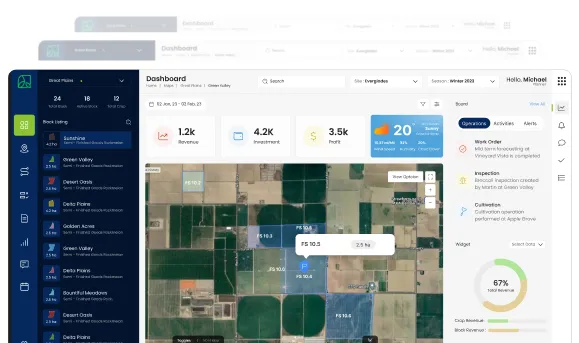
With a centralized ERP solution for farm management in place, the client gained a unified view of end-to-end operations. Financials, supply chain activities, human resources, vendors, growers, inventory, and other farm functions became easier to manage through a connected platform.

The transformation improved the farm’s ability to utilize budget and resources more effectively, reduce operational waste, and support stronger profitability. By automating repetitive tasks and improving real-time visibility, AgriERP enabled teams to save time and make more informed, data-driven decisions.

The Resulting Transformation

The implementation transformed the client’s operations from a QuickBooks-centered, manually coordinated environment into a centralized farm management ecosystem powered by Microsoft Dynamics 365 Business Central and AgriERP.

The client can now manage financials, supply chain processes, crop sales, inventory, growers, vendors, and reporting from a more unified system. This gives leadership and operational teams better control, clearer visibility, and a stronger foundation for growth.

While the original case study does not provide verified numeric ROI percentages or hours saved, the documented transformation shows clear qualitative gains in visibility, productivity, automation, reporting, and operational efficiency.

Ready to Modernize Your Potato Farming Operations with AgriERP?

See how AgriERP on Microsoft Dynamics 365 Business Central helps large-scale farms replace disconnected tools with a centralized ERP platform for finance, inventory, supply chain, crop costing, grower management, reporting, and operational control.

AgriERP Media Mentions

Partners & Affiliations

Frequently Asked Questions

What challenge did this potato grower solve with AgriERP?

The client needed to move beyond QuickBooks and disconnected tools. AgriERP helped centralize finance, inventory, supply chain, crop sales, grower management, and reporting in one ERP platform.

Business Central provided the ERP foundation for financial management, reporting, inventory, supply chain, accounting, and operational control. AgriERP extended this foundation with agriculture-specific capabilities.

By centralizing data across finance, inventory, supply chain, vendors, growers, and farm operations, the client gained better access to real-time business information and reporting.

The solution supported crop sales, grower payments, supply chain management, crop costing, financial management, intercompany transactions, depreciation management, reporting, and automation.

Yes. The same ERP approach can support other potato growers and diversified farms that need stronger financial control, inventory visibility, grower management, crop costing, and scalable operational reporting.

No verified numeric ROI, efficiency percentage, or hours-saved figure was provided in the available case study content. Any such numbers should only be added after formal client or project-team approval.