The ERP Solution for the Year” 2025 in Agtech Breakthrough Awards 2025

Building a Connected Finance and Multi-Company ERP Foundation for Schaefer Farms with AgriERP

Implementing Microsoft Dynamics 365 Business Central and AgriERP to centralize farm accounting, banking, purchasing, sales, inventory, fixed assets, and multi-company reporting across a growing Minnesota farming operation

TECHNOLOGY USED

Our Happy Customers

Client Overview

Schaefer Farms Inc. is a farming operation based in Hancock, Minnesota. The business runs a multi-entity structure that combines active farm operations with land ownership and leasing, and it needed financial management, inventory visibility, asset control, and multi-company processing to match that structure.

As Schaefer Farms planned for continued growth, its existing AgManager accounting environment could no longer support broader ERP needs. Finance and operations relied on isolated accounting records and manual spreadsheets, which created risk around reconciliation, reporting, and process consistency across the operating and land-holding entities.

As Schaefer Farms planned for continued growth, its existing AgManager accounting environment could no longer support broader ERP needs. Finance and operations relied on isolated accounting records and manual spreadsheets, which created risk around reconciliation, reporting, and process consistency across the operating and land-holding entities.

Industry

Farming / Agriculture

Location

Hancock, Minnesota, US

Structure

Multi-entity — one operating company, two land leasing entities

Operational Focus

Farm operations, land ownership, and leasing across three companies

Problem

Schaefer Farms had outgrown its AgManager accounting environment. Finance, banking, purchasing, sales, inventory, and fixed assets were managed through isolated records and manual spreadsheets, creating visibility gaps and reconciliation risk across multiple entities.

Need

A centralized, cloud-based ERP foundation to unify financial management, banking, purchasing, sales, inventory, fixed assets, and multi-company reporting, without forcing every company into the same module footprint.

Solution

Folio3 implemented Microsoft Dynamics 365 Business Central integrated with AgriERP Cloud, creating a scalable, multi-company farm ERP foundation for finance, operations, inventory, and reporting, ready to expand in future phases.

Business Challenges Before AgriERP

As Schaefer Farms planned for growth, its finance and operations teams needed more than a legacy accounting platform and manual coordination. The organization required a structured ERP foundation that could support multiple entities, financial controls, banking, inventory, assets, and consistent reporting.

The challenge was not only moving data out of AgManager. It was also creating a clean operating model that reflected how the business actually runs: an operating company alongside two land leasing entities, each with its own bank accounts, payment methods, fiscal calendar, and vendor and customer lists. Land leasing activity needed to be handled through standard General Journal processes rather than heavier intercompany complexity, and opening balances and master data needed to be migrated accurately with client sign-off before go-live.

Disconnected Legacy Systems
Delayed Inventory Reconciliation
Manual Warehouse Transactions

Manual Production Records
Limited Inventory Visibility
Inconsistent Lot & Pallet Tracking
Disconnected Data & Reporting
Uncoordinated Transportation

Implementing AgriERP for Connected Farm Operations

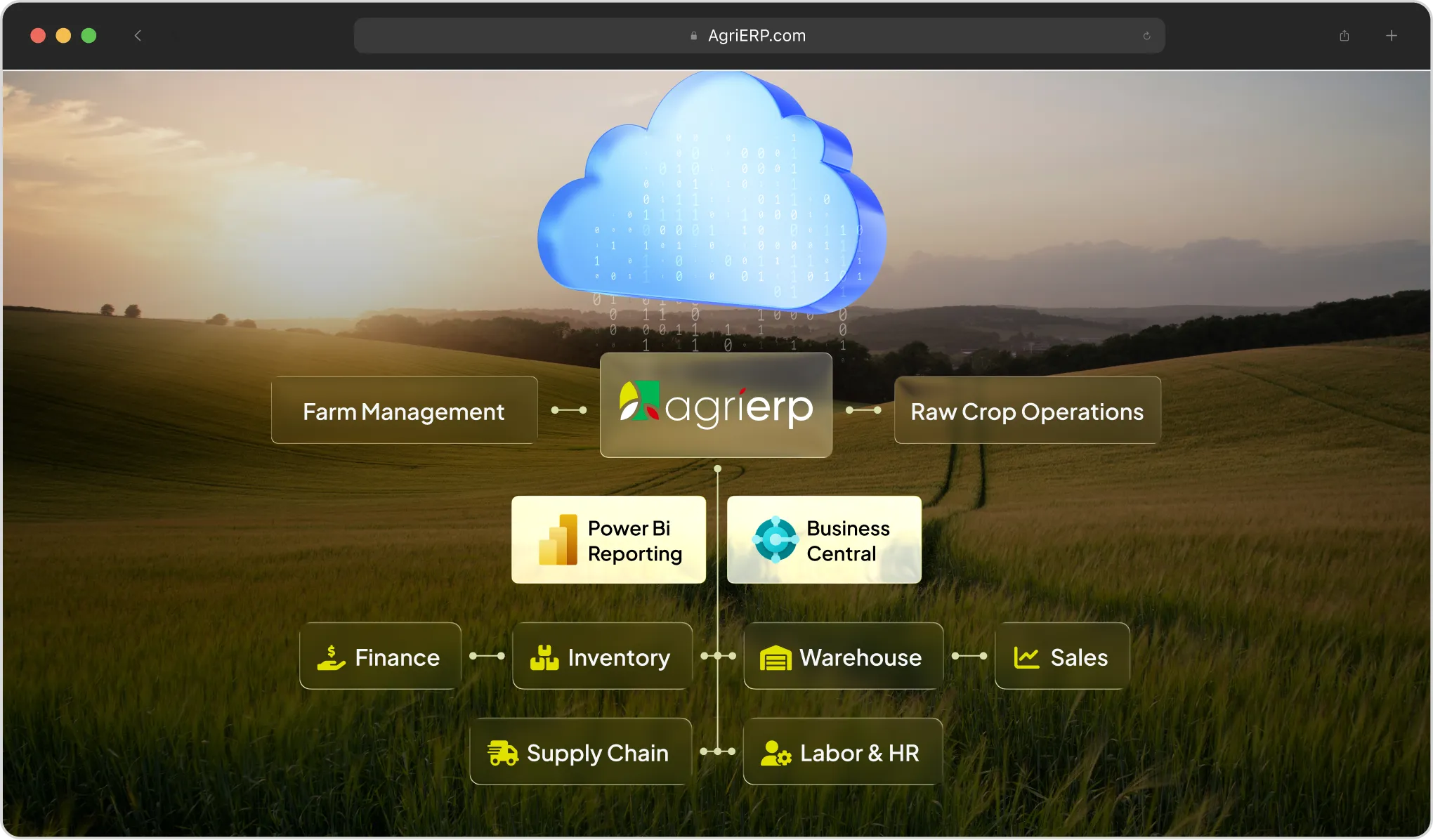
Folio3 implemented a Microsoft Dynamics 365 Business Central and AgriERP Cloud foundation designed to unify finance, banking, purchasing, sales, inventory, and fixed assets within one connected platform. Business Central served as the system of record for Phase 1, providing the standard ERP processing Schaefer Farms needs across its three in-scope companies.

The implementation emphasized standard configuration first, with limited customization only where genuinely required, such as the Schaefer Farms check layout. This approach gave the business a working ERP base quickly, reduced long-term maintenance risk, and kept room for later enhancements without overbuilding Phase 1.

Each company received the modules required for its role. Schaefer Farms was configured for the broader footprint including inventory, purchasing, and sales, while Willow Run Farms and Heritage were configured for core finance, AP, AR, cash and bank, and fixed assets as land leasing entities.

The Solution

The implemented solution combined enterprise ERP capabilities with a practical, agriculture-ready configuration. Microsoft Dynamics 365 Business Central modernized financial and operational management across three companies, while AgriERP Cloud provided the foundation to expand into deeper agriculture-specific functionality in later phases.

Financial Management and General Ledger

Centralized accounting through Business Central, including chart of accounts configured to an agriculture-appropriate standard, posting groups, dimensions, fiscal calendars, recurring journals, and consistent financial reporting across all three entities.

Accounts Payable and Receivable

Controlled AP and AR workflows with vendor payment runs, invoice settlement, customer receivables, credit memos, and aging reports, standardized across the operating and land leasing companies.

Banking and Bank Reconciliation

Entity-specific bank accounts with ACH file export, wire transfers, computerized and manual check printing, payment journals, bank feed integration through Yodlee where available, and structured reconciliation.

Fixed Asset Management

Asset master cards, classes and subclasses, two depreciation books (Financial Reporting/GAAP and Taxation), capitalization of freight and setup costs, and full lifecycle handling for acquisitions, disposals, trade-ins, and gain/loss.

Inventory and Warehouse Management

Item categories, multiple units of measure with automatic conversion, average costing, EPA numbers on chemical items, item substitutes and vendor item numbers, physical counting, and a flat location model built for practical farm storage.

Purchasing and Procurement

Standardized purchase order processing, receipts posting inventory at location, direct invoices where no PO is required, partial receipts and invoices, cost rollups for freight and charges, and external plus intercompany vendor classification.

Sales Order Processing and Contracting

Standard sales order processing plus Marketing Sales Contract support for contract pricing, terms, contract-linked orders, and partial or full shipments, with receivables booked automatically on posted invoices.

Multi-Company ERP Foundation

Three companies configured to match the real operating and land ownership model, with separate fiscal calendars, entity-specific master data, and recurring General Journal entries for land rent, without requiring the intercompany module in Phase 1.

Reporting, Analytics & Scalable Foundation

Out-of-the-box financial statements, trial balance, aging, fixed asset and inventory schedules, plus standard Power BI reporting, built on a scalable ERP foundation ready for advanced AgriERP modules, integrations, and payroll in future phases.

Functional Design and Customizations Delivered

A key success factor of the Schaefer Farms implementation was designing the ERP configuration around the organization's actual multi-entity operating model. Standard Business Central functionality was used wherever it satisfied requirements, keeping the setup clean, reliable, and easy to maintain.

Finance and Dimensions Configuration

Global Dimension 1 was configured as Growing Cycle and Global Dimension 2 as Profit Center, with Cost Center as a shortcut dimension. Recurring entries support accrued expenses and intercompany land rent through standard General Journal AP and AR activity, and deferral and amortization are handled through General Journal entries. This gave finance cleaner reporting discipline and reduced manual reconciliation effort.

Multi-Company Setup Without Overbuilding

Schaefer Farms, Willow Run Farms, and Heritage were each configured with the modules appropriate to their role, separate fiscal calendars, and companyspecific bank accounts, payment methods, vendor lists, and customer lists. Land leasing roles for Willow Run and Heritage were facilitated through the standard GL module, keeping activity separated and auditable without unnecessary intercompany complexity.

Bank, Payment, and Check Configuration

Computerized check printing was enabled for Schaefer Farms, with manual check recording and printing across all three entities. ACH export using CCD or CTX formats, Suggest Vendor Payments, payment journals, wire transfers, and Yodlee bank feed integration were configured using standard Business Central functionality where available, strengthening cash visibility and payment control.

Implementation Methodology

Folio3 followed a structured, phased implementation methodology to minimize disruption, validate data before go-live, and support user adoption. The approach moved from environment setup and configuration through migration, testing, go-live, and hypercare, all controlled through the SOW.

User Acceptance Testing and Release Management

The Schaefer Farms implementation included structured User Acceptance Testing and a controlled go- live. Business users executed standard test cases in the UAT sandbox with the same master data as production, documented outcomes, and formalized results before production migration.

Functional validation of Phase 1 modules

End-to-end workflow validation

Financial posting validation

Banking and payment testing

Inventory and warehouse testing

Fixed asset and depreciation testing

Purchasing, AP, sales, and AR testing

User guides, training, and testing guidance

Client sign-off on opening balances before production migration

Controlled go-live supported by 10 working days of hypercare

The AgriERP and Business Central deployment helped Schaefer Farms move from a legacy accounting environment and manual spreadsheets to a connected, multi-company ERP foundation where finance, banking, inventory, assets, and reporting work together. The implementation is best understood as a business control project, not just a software installation.

Business Impacts of AgriERP for Schaefer Farms

Unified ERP foundation across operating and land ownership entities
Reduced dependency on spreadsheets and isolated accounting records
Cleaner chart of accounts and posting setup aligned to Schaefer Farms
Stronger period control through posting date ranges and fiscal year handling
More disciplined AP and AR through posting groups, settlement journals, and aging reports
Improved cash visibility through ACH, checks, wires, bank feed, and reconciliation
Better inventory control using categories, units of measure, EPA numbers, locations, and average costing
Clearer asset lifecycle management from acquisition through depreciation, trade-in, and disposal
Standard reporting for trial balance, balance sheet, profit and loss, cash flow, aging, assets, and inventory
Scalable ERP foundation ready for advanced AgriERP modules, integrations, and payroll in future phases

Ready to Connect Your Farm's Finance, Inventory, and Multi-Company Operations?

Discover how AgriERP on Microsoft Dynamics 365 Business Central helps growing farms centralize accounting, banking, purchasing, sales, inventory, fixed assets, and multi-company reporting in one scalable ERP foundation.

AgriERP Media Mentions

Partners & Affiliations

Frequently Asked Questions

What challenges did Schaefer Farms solve with AgriERP?

Schaefer Farms addressed its dependency on the legacy AgManager environment, isolated accounting records and manual spreadsheets, reconciliation and reporting risk, and the complexity of managing finance, banking, inventory, and fixed assets across three separate companies.

Business Central served as the system of record for Phase 1, providing standard ERP processing for financial management, accounts payable, accounts receivable, banking, fixed assets, purchasing, sales, inventory, and reporting across the operating and land leasing entities.

AgriERP Cloud provided the agricultureready ERP foundation on Business Central, including a flat inventory location model for farm storage points, EPA number tracking on chemical items, and configuration built to expand into deeper agriculture-specific modules in future phases.

Schaefer Farms was configured as the operating company with the broader module footprint including inventory, purchasing, and sales. Willow Run Farms and Heritage were configured as land leasing entities with core finance, AP, AR, cash and bank, and fixed assets. Each company kept its own fiscal calendar and master data.

Land rent and related company transactions were supported through recurring General Journal entries in the standard GL module, avoiding the need for the Business Central Intercompany module in Phase 1 while keeping activity separated and auditable.

The solution centralizes inventory and warehouse management with item categories, multiple units of measure, average costing, physical counting, and a flat location model where seed sheds, chemical sheds, fertilizer tanks, and similar storage points are configured as distinct locations.

Folio3 used standard data migration templates for master data, opening balances, inventory, customers, and vendors. Open purchase orders, sales orders, and marketing sales contracts were migrated while historically closed documents were excluded. Client sign-off on opening balance accuracy was required before production migration.

The implementation helped unify finance and operations across three entities, reduce spreadsheet dependency, improve reporting and reconciliation, strengthen banking and payment control, improve inventory and asset visibility, and create a scalable ERP foundation for future growth.

Yes. The Business Central and AgriERP foundation can support future initiatives such as approval workflows and role-based security, advanced reporting and budgeting, HR and payroll extensions, third-party integrations, advanced AgriERP modules, and an intercompany module if cross-entity processing grows more complex.

Yes. The Schaefer Farms implementation shows how AgriERP can support multi-entity US farming operations that combine active farm operations with land ownership and leasing, each with distinct financial, banking, and reporting requirements.