The ERP Solution for the Year” 2025 in Agtech Breakthrough Awards 2025
Implementing Microsoft Dynamics 365 Finance & Supply Chain Management with Advanced Warehouse Management, Transportation Management, and custom production execution to standardize operations and establish an integrated foundation for specialized livestock operations through AgriERP.




Superior Farms is a well-established American lamb company with operations spanning rancher partnerships, processing, packaging, distribution, and customer fulfillment. The company is recognized for its focus on product quality, sustainability, innovation, and employee ownership.

As the business continued to scale, operational complexity increased across receiving, inventory handling, cold storage, production execution, warehouse movements, shipping, transportation coordination, and financial reconciliation. The organization needed an enterprise-grade digital ecosystem to improve operational discipline, gain real-time visibility across departments, and support both day-to-day livestock processing and future automation, mobility, and analytics initiatives.
Processors
Davis, California US
400+ employee-owners
Process and market American lamb across retail and foodservice, with farm-to-table sourcing through family rancher partnerships.
Manual warehouse transactions, disconnected production records, and uncoordinated transportation created data silos, inventory mismatches, and limited visibility across supply chain and operational processes.
A centralized ERP platform to standardize and automate finance, warehouse, production, and logistics execution, strengthen inventory controls, and enable integrated operational and financial reporting.
Microsoft Dynamics 365 Finance & Supply Chain Management was implemented as the ERP backbone, with custom production and warehouse layers and AgriERP introduced as a specialized livestock operations layer integrated with the Dynamics 365 foundation.

Superior Farms was operating with disconnected systems and manual processes that forced finance, warehouse, production, and logistics teams to work in silos. Warehouse activities lacked system-directed controls for receiving, put-away, replenishment, picking, staging, and shipment confirmation, while inventory visibility across storage locations, production areas, and staging required improvement. Lot, pallet, and license plate tracking were not consistently embedded into execution, increasing the risk of inventory mismatches and delayed reconciliation. On the production floor, teams relied on manual records that created delays between physical execution and system updates, and outbound shipment planning lacked coordination between staging, loads, routes, and carriers. As a result, operational data from warehouse, transportation, and production activities did not flow consistently into financial reporting, preventing a single source of truth and real-time visibility.
Folio3 implemented Microsoft Dynamics 365 Finance & Supply Chain Management as the centralized ERP platform to standardize finance, procurement, inventory, warehouse, production-related, and transportation processes across Superior Farms. The approach focused on replacing manual handling with system-directed workflows, improving data consistency, and enabling automation through mobile and web execution layers.
In parallel, Advanced Warehouse Management, Transportation Management, the Microsoft Warehouse Management app, a custom Ardia production web app, and a custom F3 WMS layer were introduced to capture real-world execution, while AgriERP established the foundation to integrate livestock operations data with Dynamics 365 so supply chain and financial processes reflect activity on the production floor.
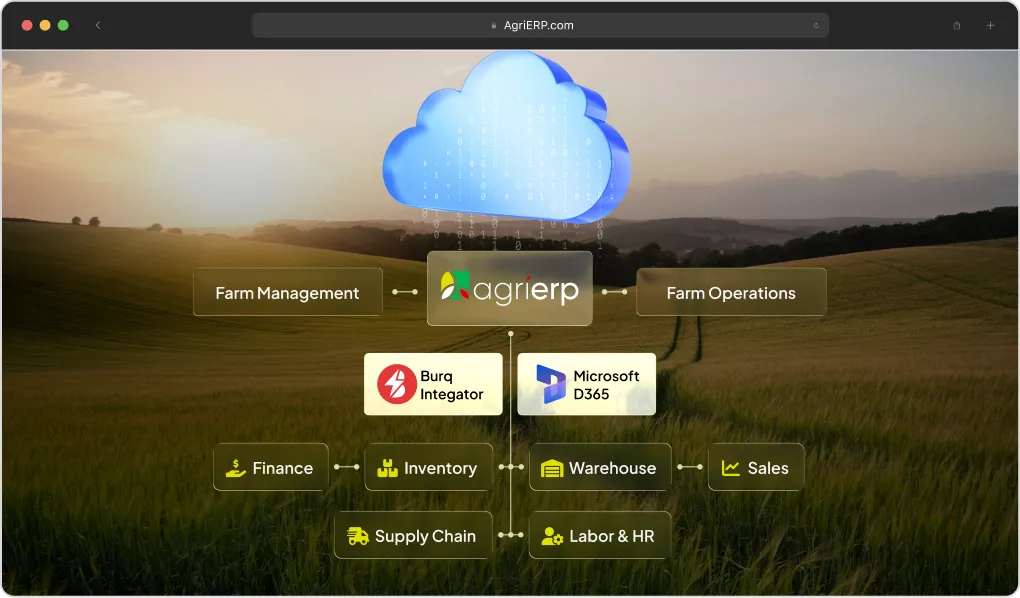
The solution established Microsoft Dynamics 365 Finance & Supply Chain Management as the system of record for finance, procurement, inventory, sales order processing, warehouse management, transportation, and reporting. Advanced Warehouse Management brought system-directed control to warehouse execution; Transportation Management connected outbound fulfillment with shipment planning; the custom Ardia web app streamlined production-floor execution; the Microsoft Warehouse Management app delivered guided mobile transactions; and the custom F3 WMS layer addressed Superior Farms-specific warehouse flows. Burq Integrator synchronized these execution layers back to the ERP, with AgriERP designed as the specialized livestock operations layer integrated with the Dynamics 365 foundation.

The transformation replaced fragmented tools with a centralized ERP backbone supporting finance, warehouse, production, and supply chain operations from a single data foundation. Delivered capabilities include:
Discover how a purpose-built ERP foundation helps your operation strengthen warehouse control, production traceability, and end-to-end visibility from receiving to shipment.


EnH Farms addressed spreadsheet dependency, disconnected finance and field operations, limited inventory traceability, manual work orders, fragmented reporting, manual sales contract processes, and delayed visibility into harvest and operational activity.
Business Central served as the core ERP foundation for financial management, accounts payable, accounts receivable, procurement, inventory, banking, fixed assets, intercompany accounting, consolidation, sales order processing, and reporting.
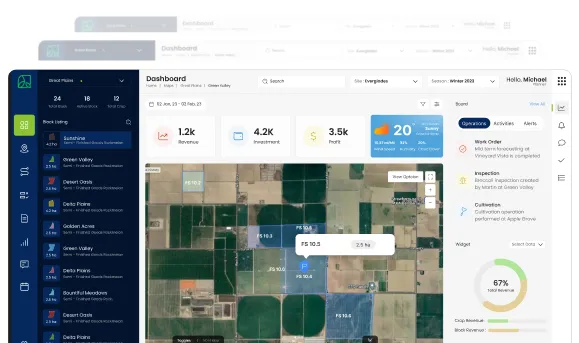
AgriERP Web and Mobile enabled crop planning, plot visualization, work order execution, harvest operation management, inspections, observations, harvest ticket processing, geo-location capture, resource allocation, and project costing.
The AgriERP mobile application allowed field users to capture updates from farm locations, including work order progress, inspections, harvest tickets, and geo-location-based activity. Offline support helped teams continue working in low-connectivity environments.
Key customizations included Task Template ID automation on the Project Card, automated task line and planning line imports, bulk Sync to Farm App functionality, marketing sales contract management, shipment assignment automation, harvest quantity posting, inspection templates, proof-of-delivery integration, and reconciliation workflows.
The solution centralizes inventory and warehouse management while connecting harvest activities, harvest tickets, lot tracking, item master data, and operational updates with the ERP system. This improves traceability, reporting accuracy, and management visibility.
Field execution data captured through AgriERP can support project costing, resource tracking, inventory movements, and financial visibility in Business Central. This helps reduce delays between farm activity and back-office accounting processes.
The implementation helped centralize finance and operations, reduce spreadsheet dependency, improve reporting, enhance inventory traceability, digitize field execution, improve harvest management, and create a scalable ERP foundation for future growth.
Yes. The Business Central and AgriERP foundation can support future initiatives such as predictive analytics, IoT integrations, irrigation automation, equipment telemetry, grower portals, advanced dashboards, AI-driven insights, and third-party agricultural integrations.
Yes. The EnH Farms implementation shows how AgriERP can support diversified US farming operations with multiple crop cycles, financial entities, inventory requirements, field execution workflows, and reporting needs.