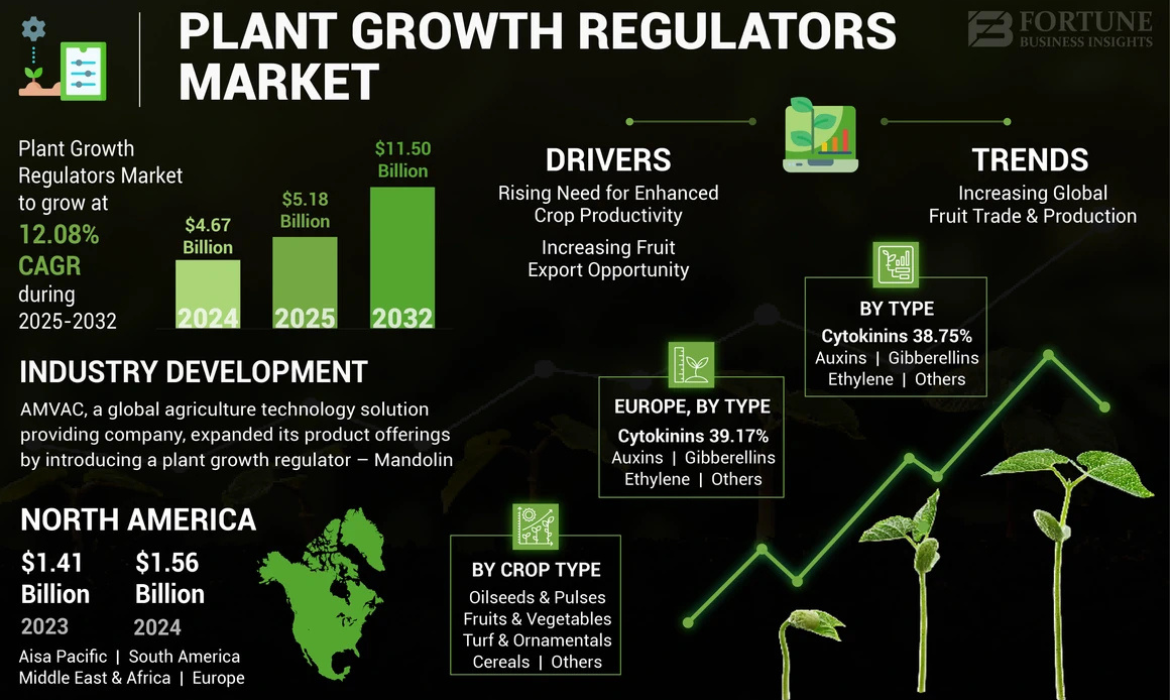
The Plant Growth Regulators Market continues to expand as farmers, horticulturists, and urban growers seek tools to boost yields, improve stress tolerance, and meet sustainability goals.
With applications spanning large-scale crop production, organic farming, and turf management, PGRs are positioned at the nexus of productivity and environmental stewardship. Leading suppliers are innovating bio-based formulations and precision-delivery systems, even as regulatory frameworks tighten, particularly in Europe and Asia Pacific.
These compounds align well with eco-friendly farming practices and contribute to innovations in sustainable agriculture adoption worldwide.
As arable land per capita shrinks and climatic stresses intensify, the imperative for higher crop productivity without environmental compromise has never been clearer.
Plant growth regulators (PGRs), a class of naturally derived or synthetic compounds that modulate plant hormones, offer a targeted solution. From stimulating root development and flowering to delaying senescence and enhancing fruit set, PGRs are becoming indispensable across agriculture and urban landscaping.
Market Overview
The Plant Growth Regulators Market comprises both natural extracts (e.g., seaweed, humic acids) and synthetic hormones, auxins, gibberellins, cytokinins, ethylene inhibitors, and abscisic acid analogues. These compounds influence processes such as cell division, stem elongation, root initiation, flowering, and fruit maturation. The Plant Growth Regulators Market comprises both natural extract
In 2018, global PGR revenues stood at approximately US$5.6 billion; steady mechanization and sustainability trends are projected to drive the market towardUS$8 billion by 2027.
Key Market Drivers
Intensification of Scientific Farming Governments and agribusinesses are channeling capital into precision agriculture drones, sensor networks, and AI-driven analytics. These technologies enable targeted PGR application, optimizing timing and dosage to enhance efficacy and minimize waste. In staple crops like rice, wheat, and maize, well-timed PGR sprays have demonstrated yield uplifts of 5–15%, fostering wider adoption among progressive farmers.
Rise of Urban and Controlled-Environment Agriculture Indoor farms and vertical-farming operations require PGRs to manage plant architecture and synchronize harvests. By modulating ethylene responses and cytokinin levels, operators can standardize fruit development in high-density settings. Similarly, turf managers use gibberellin inhibitors to regulate grass height and improve wear tolerance, reducing mowing frequency and water usage.
Demand for Eco-Friendly and Organic Inputs As the global organic food market surpasses US$140 billion, growers increasingly seek residue-free growth aids. Biostimulants derived from marine algae, microbial fermentates, or plant extracts are being classified alongside PGRs under integrated crop management programs. These products promise natural mode-of-action profiles and align with stringent Maximum Residue Limit (MRL) regulations in markets like Germany, France, and Japan.
Opportunities
Precision Delivery Technologies: Nano-encapsulation and micro-emulsion platforms can improve PGR stability and uptake while reducing run-off.
Digital Integration: Linking PGR regimes with crop-management software and remote sensing creates data-driven recommendations and traceability.
Emerging Crops: Specialty fruits, hemp, and medicinal plants represent underexploited segments where tailored PGR formulations can unlock new value chains.
Challenges and Regulatory Landscape
PGRs often fall under pesticide or biocide legislation, invoking rigorous registration pathways. In the EU, dossiers must address environmental fate, non-target toxicity, and MRL compliance, lengthening time-to-market and inflating R&D costs.
Over-application risks include irregular ripening and hormone carryover, which can undermine farmer confidence. Smaller innovators struggle with the high entry barriers, leading to a market dominated by well-capitalized multinationals.
Regional Insights
Europe With around 8% of EU farmland certified organic, Europe leads in residue-free agriculture. Incentives for eco-schemes and the Farm to Fork Strategy bolster PGR alternatives. Nevertheless, companies face the dual pressures of sustainability targets and the Farm and Soil Protection Directive, which mandates comprehensive environmental impact assessments.- Eurostat Organic Farming Statistics
Asia Pacific Rapid population growth and arable land scarcity in China and Southeast Asia are driving PGR consumption. Indian agrochemicals giants (e.g., TATA Chemicals, UPL) are investing in bio-PGR R&D, while China’s state-backed initiatives promote drought-tolerance enhancers. Government subsidies on precision-spraying equipment further catalyze market expansion.
North America & Latin America In the U.S., turf management and specialty horticulture remain mature PGR segments, supported by extension service recommendations. Meanwhile, Brazil and Argentina are scaling PGR use in soy, maize, and sugarcane to mitigate climate variability. Favorable farm-gate prices and precision-ag advisories underscore the region’s growth potential.
Competitive Landscape
The market is moderately consolidated, with top players commanding roughly 40% of global share. Collaboration between chemical majors and ag-tech startups is fostering innovations in formulation and digital application.
AgriERP is a comprehensive farm management solution designed to empower farmers with streamlined operations and increased profitability. Powered by Microsoft Dynamics 365, AgriERP offers a single, straightforward platform that addresses the pain points of various farm types. With its user-friendly interface and intelligent automation, AgriERP is like having a trusted partner by your side throughout your farming journey.
For more information about AgriERP and its innovative farm management solutions.
Recognized as the top data analytics platform in agriculture at the 2026 AgTech Breakthrough Awards. Trusted by farm owners, processors, and exporters to turn operational data into better decisions.
 Data Analytics Solution of the Year” 2026 in Agtech Breakthrough Awards 2026


 AgriERP Expert
  July 16, 2025