The ERP Solution for the Year” 2025 in Agtech Breakthrough Awards 2025
You already own the sensors, the yield monitors, and the FieldView subscription. What you don't own is a system that reconciles all of it against your inventory, your input costs, and your books. AgriERP is where the data finally lands somewhere useful.


The industry says 72% of farms now collect field-level data. What the industry does not say is how much of that data actually reaches an accounting record, a purchase decision, or a lender report. Most of it sits in the tool that captured it.
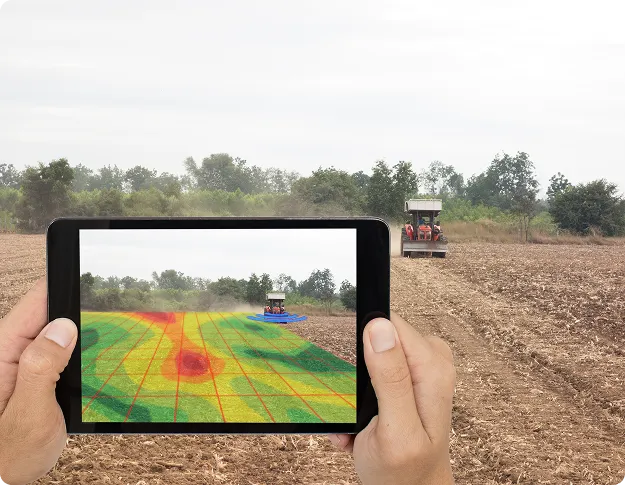
FieldView shows you which zones underperformed. Your accounting shows you the total input spend. What no system shows you is cost per bushel on the zone that underperformed, because the yield data and the input cost live in different places.
Soil moisture sensors, weather stations, and silo monitors generate live data. None of it triggers a purchase order, updates an inventory record, or flags a covenant issue. It ends up as dashboards nobody opens.
You pay for FieldView, for Operations Center, and for a satellite imagery service. Each has its own login, its own dashboard, and its own export format. Combining them into a single view of the farm is a spreadsheet somebody rebuilds every month.

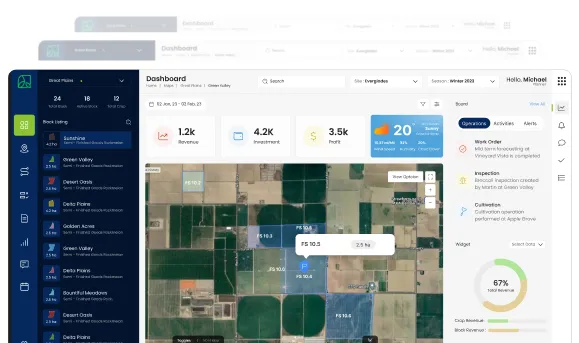
AgriERP ingests from the precision ag and IoT tools you already own, reconciles the data against fields, inputs, and inventory, and turns it into decisions your finance team and your lender can use.
Yield maps, prescriptions
Application records
Field boundaries, guidance
Soil moisture, weather, silo
Inputs allocated to zones
Against live inventory
Live from operational data
Informed by prior yield
AgriERP is not another precision agriculture tool. You already have those. AgriERP is the system of record that ingests from them and turns the data into cost per acre, inventory action, and financial results. The mapping stays where it is. The decisions land here.
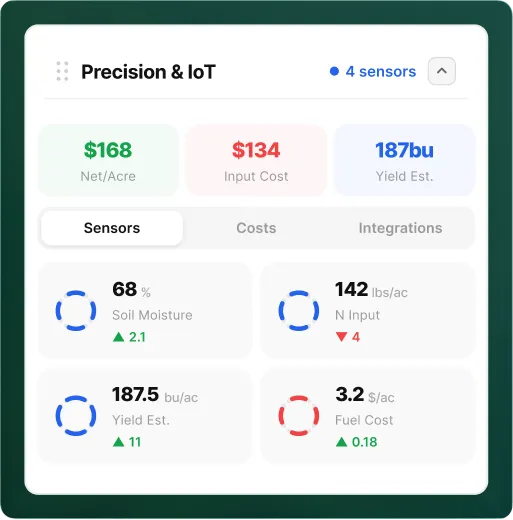
Zone-level yield from FieldView reconciles against zone-level input spend, so cost per bushel is a field-level number rather than a farm-level average.
Soil moisture drops below threshold, and the irrigation record updates. Silo weight changes, and the inventory record updates. Sensor readings become operational events, not dashboard entries.
The prescription mapped in FieldView reconciles against what you actually have in the shed. Under-supply is flagged before you get to the field.
Six things your whiteboard, spreadsheet, and walk-through cannot handle once the operation gets serious.
Native connectors for Climate FieldView, John Deere Operations Center, Trimble Ag, and Ag Leader SMS. Yield maps, application records, prescriptions, and field boundaries flow into AgriERP without a spreadsheet stage between them.

Soil moisture, weather station, silo weight, temperature, and greenhouse sensors ingested through standard IoT protocols. Sensor readings become operational events on the record they relate to: a field, an irrigation cycle, an inventory location.
Yield data from precision ag platforms reconciles against input cost, labor, and machine hours at zone level. Cost per acre and cost per bushel by management zone, not just by farm.
A variable rate prescription drafted in FieldView or FARMserver is more than a map. It is a claim on input inventory. AgriERP reconciles the prescription against what is actually on hand, so under-supply is flagged before the sprayer leaves the yard.
Engine hours, fuel use, and location data from connected equipment feed into asset records for maintenance scheduling, cost allocation, and depreciation. The tractor that ran 320 hours across four fields has 320 hours costed against those fields.
Field data lives in AgriERP in standardized formats (GeoJSON for boundaries, ISOXML for prescriptions, standard CSV for time-series). If you change precision ag providers, your operational history stays with you.
Bring one field, one prescription, and one week of sensor data. We will show you what zone-level cost per acre, variable rate reconciliation, and threshold-triggered inventory look like when the data actually flows.
The buyer for this page already owns precision ag subscriptions and IoT hardware. The problem is not collecting more data. The problem is doing something with what is already there.

You bought into precision agriculture years ago. Yield maps, prescription mapping, and in-cab guidance are already in place. What is not in place is a system that turns any of it into a financial decision. AgriERP is that system.
Soil moisture sensors, weather stations, silo weight monitors, and greenhouse climate sensors generate data every hour. AgriERP turns those readings into operational events: an inventory update, a threshold alert, a purchase requisition. The data lands somewhere useful.
Case IH in the spring, New Holland in the fall, a Trimble display in one tractor and a John Deere display in the next. Each system captures its data in its own format. AgriERP is the operational layer where all of it converges into one field record.
Rombola Family Farms moved to AgriERP on Microsoft Dynamics 365, digitizing processes that had previously been manual and fragmented. The result was data visibility across the operation that supported informed decisions at every stage, from input planning through harvest, rather than decisions made on instinct and end-of-season reports.



No. FieldView, Operations Center, Trimble Ag, and Ag Leader SMS do things AgriERP does not do: yield mapping, prescription drafting, in-cab guidance, satellite imagery analysis. AgriERP is the ERP that ingests from all of them and reconciles the data against inventory, cost, and financial records. Keep the tools you already own; AgriERP is where their data converges.
Native connectors for Climate FieldView, John Deere Operations Center, Trimble Ag, and Ag Leader SMS. Yield maps, application records, prescriptions, and field boundaries flow in without manual export or spreadsheet reformatting. Additional platforms can be connected through standard APIs.
MQTT and LoRaWAN are supported natively, along with standard HTTP-based APIs for sensor vendors that publish data through their own cloud. Soil moisture, weather station, silo weight, temperature, and greenhouse climate sensors are the most common configurations.
AgriERP does not draft prescriptions; that job stays with FieldView, FARMserver, or whichever precision ag tool you use for prescription mapping. What AgriERP does is reconcile the prescription against inventory on hand and post application records back against input consumption, so the prescription becomes an inventory-aware decision rather than a standalone map.
Field data lives in AgriERP in standardized formats: GeoJSON for field boundaries, ISOXML for prescriptions, standard CSV for time-series. If you switch providers, your operational history stays with you rather than being trapped in the outgoing vendor's cloud.
Data ingested from Case IH, New Holland, John Deere, and Trimble displays lands in one field record. Field boundaries, application records, and machine hours are held in standardized formats regardless of the brand that captured them. ISOXML prescription formats are supported for cross-brand execution.
For most operations it becomes the financial core, since AgriERP runs on Microsoft Dynamics 365 Business Central. Operations that already use Xero or MYOB in Australia can connect them where those are already in place. Migration from standalone accounting and inventory systems is supported with structured data extraction and reconciliation before go-live.